

Balancing capacity cooperation ALPACA
ALPACA (Cooperation Agreement on the Allocation of Cross-Border Capacity and the Procurement of aFRR) facilitates the joint, cross-border procurement of aFRR balancing capacity between AT, CZ, and DE and is based on a TSO-TSO model. For this, the respective TSOs remain responsible for dimensioning, prequalification, procurement and activation of aFRR. They also remain the single point of contact for balancing service providers which are connected within the respective load-frequency control area. This means that for balancing service providers in Austria APG’s tendering platform remains the main interface.
Common Procurement Optimization
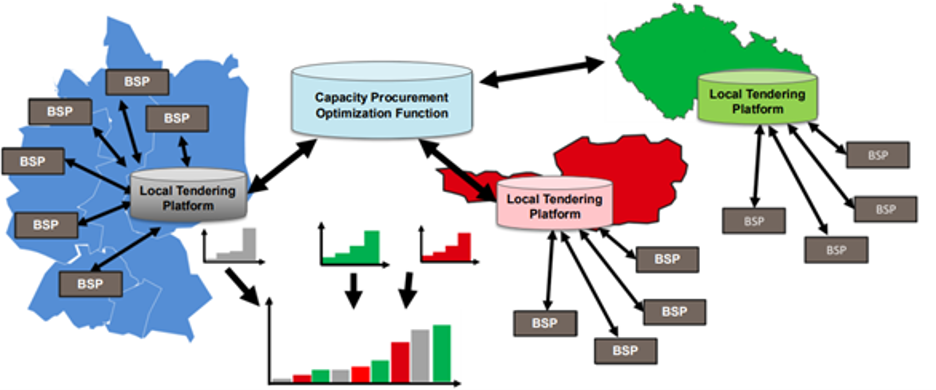
Based on the dimensioning rules, the aFRR demand in Austria, Czechia and Germany is procured via daily simultaneous (national) tenders. A common procurement optimization function (CPOF) determines the economically most efficient selection of bids, taking into account the maximum exchange limits per border. This joint procurement can lead to situations where one control block procures more aFRR than needed to cover its demand, which means that the other, cooperating, control block can procure less. The total sum of procured aFRR capacity will, however, always suffice to cover local demands. As usual, the information about selected bids is published on the respective national tendering platforms.
Basic function and Constraints
The cross-border procurement of balancing capacity is based on joint optimization via the CPOF (“Common Procurement Optimization Function”). The algorithm is designed to minimize the total procurement costs of the specified products while satisfying the constraints and to provide information about the selected bids.
The objective function of the CPOF is to minimize the total procurement costs within the cooperation, i.e., the sum of the awarded balancing capacity multiplied by the respective balancing capacity price according to the pay-as-bid mechanism.
The constraints of the CPOF are as follows:
1. The CPOF must accept enough bids to cover the total demand.
2. The locally procured quantity of balancing capacity must correspond to at least the country’s core share. The core share is the minimum quantity that a TSO must procure locally according to the System Operation Guideline (SOGL).
3. The maximum exchange limits must be adhered to.
4. It must not be possible for a country to simultaneously import and export the same product (positive or negative aFRR).
5. If two separate bids have the same price and the algorithm is to select only one bid (multiple optimal solutions), the selection must be based on a random algorithm that does not discriminate against certain balancing service providers and gives priority to procurement within the country itself.
Further details, including examples, can be found here.
Maximum Exchange Limits
Cross-border procurement is limited, among other things, by maximum exchange limits per border. Various methods are used to define these maximum exchange limits. At the Austria-Germany border, the method of allocating cross zonal capacity based on a cost-benefit analysis continues to be used. At the borders with the Czech Republic, a probabilistic method is applied.
Border AT-DE
Allocation of Cross-zonal Capacity for the Exchange of aFRR Capacity
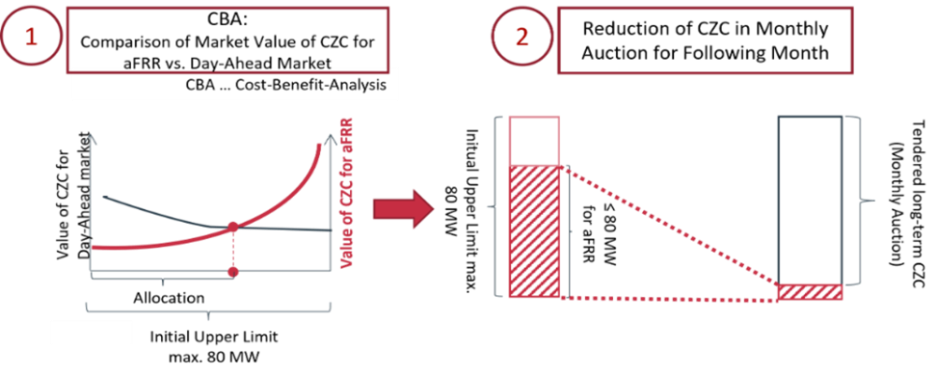
DE and AT TSOs allocate CZC for the exchange of aFRR capacities between their border. This allocation allows them to access the necessary aFRR that is connected to the cooperating control block at any time. The volume of CZC allotted for the exchange of aFFR between Austria and Germany is thus deducted from the tradable volume which is tendered in the monthly JAO-auction.
To determine the optimum allocation of CZC for the exchange of aFRR capacity, APG and the German TSOs developed a cost-benefit analysis (CBA) that compares the market value of CZC on the day-ahead market with the market value of CZC for the aFRR market. The CBA is performed before the monthly auction of CZC. For the initial phase of the joint aFRR procurement the maximum allocation of CZC is limited to 80 MW. Figure 2 illustrates the comparison of market values and the resulting allocation of CZC.
Release of Cross-zonal Capacity for the energy market
Following the monthly process to determine the allocation of CZC, the final volume of CZC is re-evaluated on a weekly basis. This means that before each GOT of the first aFRR capacity auction of a calendar week an additional CBA is performed. Analogous to the monthly CBA, the market value of allocated CZC for the aFRR market is compared with the market value of allocated CZC for the day-ahead market. In case the weekly cost-benefit analysis results in a lower optimum allocation, the difference between the monthly and weekly result will be returned to the intraday market. Figure 3 illustrates the monthly allocation process as well as the weekly re-evaluation and release of CZC.
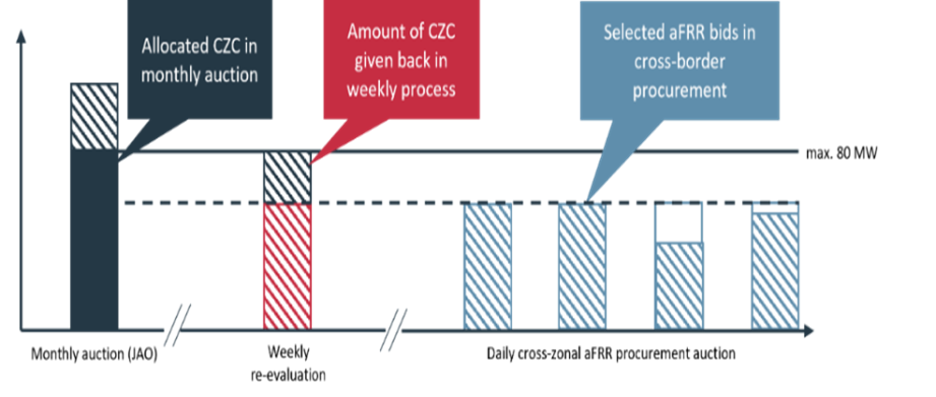
CZC which is not needed for the exchange of aFRR capacity will be released according to the increase process of the Core region and returned to the intraday market. In case of a release of CZC, an "increase request" is put forward to increase the capacity volume of CZC available on the intraday market. However, whether this request is approved depends on the general situation of the transmission grid.
Border AT-CZ
Calculation of initial exchange limit
ALPACA applies on the borders of Austria to Czechia and Czechia to Germany the probabilistic method based on Art 33(6) EBGL, which allows a cross-border balancing procurement based on a probability calculation of available cross-zonal capacity (CZC / ATC) after intraday cross-zonal gate closure time.
Therefore, two Forecasting Tools (FOX, TIGER) were developed. Both Forecasting Tools assess the following risks:
(Risk 1) The risk of unavailable CZC due to un/planned outage or congestion, i.e., the probability that available CZC is lower than the procured balancing capacity at the respective border;
(Risk 2) The risk that the local balancing energy demand cannot be covered with locally pro-cured balancing capacity;
(Risk 3) The risk of insufficient reserve balancing capacity due to unavailability of CZC, i.e., the probability of an area’s aFRR demand (balancing energy) being above a certain value of local procurement and at the same time not enough CZC is available to access cross-border pro-cured balancing capacity to meet this aFRR demand.
In the forecasting process, a forecasting algorithm will estimate the probability of available CZC being equal to or lower than various scenario values or forecasting ranges.
The forecasting ranges are defined by the ProbM border per product (negative/positive) and go from 0 to 100 MW per direction and border. The increments between each scenario shall be set up by each Forecasting tool individually.
The forecasted probability presents an estimate for the risk of unavailable CZC due to un/planned out-age or congestion (Risk 1) for a given scenario value. Combining this risk with the risk that the local balancing energy demand cannot be covered with locally procured balancing capacity, due to the un-availability of the cross-border procured volume (Risk 2) yields an estimate of the risk of insufficient reserve capacity (Risk 3), i.e. the probability that the actual available CZC is lower than the forecasted available CZC multiplied by the probability that the forecasted value of cross-border procured capacity is needed to satisfy local aFRR demand.
TSOs will determine acceptable risk values for the risk of unavailable CZC (Risk 1) and the risk of insufficient reserve capacity (Risk 3). Those values will enter the risk assessment in which the initial ex-change limit will be determined in such a way that these limits respect the acceptable risk chosen by TSOs, while choosing the largest forecasted scenario value. In other words, acceptable risks for Risk 1 and Risk 3 filter all scenarios per border, direction, product and 4h-block to receive the maximum possible amount of exchange under the defined maximum risks. This value is the Initial Exchange Limits (IEL) and is used as an input for the Capacity Procurement Optimisation Function (CPOF).
Calculation of the Maximum Exchange Limit
In addition to the individually acceptable risk values in the probability calculation, the countries have the option of defining an individual security limit in MW that must not be exceeded.
The minimum of the security limit and the result of the probability-based calculation (IEL) is incorporated into the CPOF as the maximum exchange limit (MEL).
For more information, see “Documentation & Public Consultation” under ALPACA: Cross-Border Balancing Capacity Cooperation for aFRR
Settlement
The joint procurement of aFRR can lead to situations where one control block procures aFRR for the cooperating control block. To make sure that no TSO incurs additional costs, the costs of aFRR capacity which is procured for the cooperating control block must be settled between the TSOs. This TSO-TSO settlement is based on a model in which the most expensive bids which are selected in addition to those covering the local demand have to be compensated by the cooperating control block.
Publication
The results of a balancing capacity auction are published within 30 minutes after gate closure time.
Ansprechpartner

Market Operations
Grid control
Information about the stability of the grid frequency, the control reserve market and essential basics of grid control.
Secondary control
Tenders for the secondary control reserve in the APG control area and frequently asked questions about secondary control.